MicroCarb
MicroCarb is a joint mission between the UK Space Agency and CNES that will measure sources and sinks of carbon, the principal greenhouse gas driving global warming.
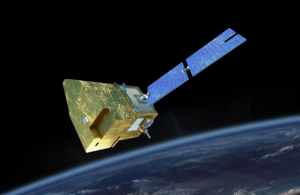
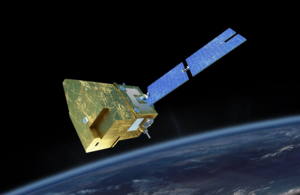
Artist Impression of Microcarb. Credit: CNES.
Understanding the behaviour and dynamics of greenhouse gases in the Earth’s atmosphere, and the processes by which they are produced and absorbed, is a key part of understanding our changing climate.
MicroCarb is the first European mission intended to characterise greenhouse gas fluxes on Earth’s surface and gauge how much carbon is being absorbed by oceans and forests, the main sinks on the planet.planet.
MonitoringAdding to the work of previous CO2 missions, Microcarb will become part of an international greenhouse gas monitoring network of satellites, and collect more precise data on CO2 emissions than ever before. This will improve our understanding and monitoring ability of the natural carbon cycle and emissions from human activity. Microcarb will also monitor international progress towards meeting the Paris Agreement to limit global surface warming, and allow us to anticipatedetermine how themuch ecosystemscarbon is being absorbed by natural processes and how much is being emitted by human activity.
Microcarb’s city-scan observing capability will reactmap atmospheric CO2 over cities, providing insights for cities to globalincorporate warming.sustainability Theinto UKtheir hasurban aplanning.
Monitoring rangegreenhouse ofgas rolesdata fromwill assemblingallow us to anticipate how ecosystems, habitats and testingsocieties thewill satellite,react groundto segmentclimate algorithmschange, and provide insights on how to leadingmitigate and minimise damage.
On 2 February 2024, it was announced that Microcarb was ready for launch. The completed satellite was delivered by Thales Alenia Space UK scientists(TAS onUK) to the MissionFrench AdvisorySpace Group.Agency, CNES, where it awaits shipment for launch.
Launch is expected no earlier than 2025.
KeyInstrumentation factsand measurement
DataOnce fromlaunched, MicroCarbMicrocarb will helporbit usat toan monitoraltitude internationalof progress650km, and will repeat its cycle of observation and measurements every 21 days.
It will carry an infrared spectrometer, which will measure O2 and CO2 concentrations at 4 different spectral bands in meetingsunlight reflected off the ParisEarth: Agreement0.76μm, climate1.27μm, target1.6μm and 2μm.
The infrared spectrometer’s degree of limitingprecision globalwill surfacebe warmingextremely tohigh. wellMeasurements belowof 2ºCCO2 concentrations will be in the order of pre-industrial1ppm temperatures.
MicroCarb(part hasper million), with a specialpixel size of 4.5x9km. The city-scanning observing mode that will allowhave us,a forresolution theof first2x2km2.
MicroCarb time,will toalso mapretrieve CO2Solar emissionsInduced acrossFluorescence cities(SIF), which arewill provide data about photosynthetic activity and enrich data from CO2 observations about carbon sinks.
How is the UK involved?
The UK has a largerange contributorof roles from assembling and testing the satellite, ground segment algorithms to globalleading emissions.UK scientists on the Mission Advisory Group.
The UK is involved with the Assembly, Integration and Testing of satellite, design and build of key parts, data collection, algorithm development and scientific mission preparation.preparation.
The missionUK isSpace dueAgency invested £13.9 million in the mission, securing the following UK expertise:
The National Physical Laboratory (NPL) has provided the SI-traceable ground calibration facility, to launchtest noits earlierperformance thanpre-launch. 2025.Paul Green of NPL has developed algorithms and quality metrics with the MicroCarb team.
Stakeholders:Thales CNES,Alenia TAS-UK,Space UK (TAS UK) is completing the assembly, integration and testing at STFC RAL Space,Space NPL,in GMV,Harwell, UniversityOxfordshire.
STFC RAL Space has designed the pointing and calibration system, enabling MicroCarb to take measurements at specific locations.
GMV UK are designing, implementing and quality assuring algorithms and operational processors for several CO2 data products.
Professor Paul Palmer of Leicester,the National Centre for Earth Observation (NCEO) and the University of Edinburgh will translate MicroCarb’s CO2 observations into maps that show carbon absorption and emissions.
Dr Rob Parker is part of the NCEO team delivering the mission’s Solar Induced Fluorescence retrieval algorithm, based on expertise from the University of Leicester.
Updates to this page
Last updated
-
Updates and more detail added about the mission, and the page has been restructured.
-
Updated information.
Update history
2026-08-20 15:44
Updated with latest mission information.
2024-08-09 09:15
Updates and more detail added about the mission, and the page has been restructured.
2023-07-14 11:07
Updated information.