Lives to be saved by boosting access to drug overdose medication
Government launches consultation to help combat rising frigdrug deaths from opioids, as part of record £3.4 billion in investment in drug and alcohol services.
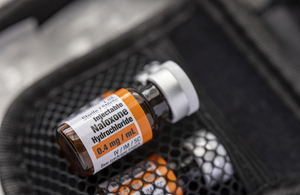
- Naloxone to be made accessible at homeless shelters and to the public in emergencies
- Government launches consultation to help combat rising drug deaths from opioids
- Part of record £3.4 billion investment including in drug and alcohol treatment and education services
Hundreds of people at risk of overdosing on opioids could be saved by providing homeless shelters with access to naloxone.
The government has unveiled plans to expand access to the life-saving medication that reverses opioid overdoses,overdoses, with a 10-week UK-wide consultation launched today.today (29 December 2025).
The move is a central part of the government’s comprehensive approach to drug and alcohol misuse and treatment, supported by a record £3.4 billion over the next three3 years up to 2029.
Drug-related deaths have doubled since 2012, with a record 5,4485,565 lives lost in England and Wales last year alone. Deaths involving nitazenes, a synthetic opioid, in England have increased substantially from 52 reported deaths in 2023,2023 to 180195 deaths in 2024.
Minister of State for Health Karin Smyth said:
Every drug death is a preventable tragedy. Naloxone is a safe, effective medication that can reverse an opioid overdose and give someone the chance to access treatment and rebuild their lives.
We want to remove the barriers which prevent naloxone reaching the people who need it most at that moment when their life is on the line.
That is why we are launching this consultation to change the regulations and make sure those coming in contact with opioids through their work - or members of the public faced with an emergency - can save a life.
The government is consulting on amending regulations to allow us to:
Expandexpand supply of naloxone to hostels, day centres and outreach services for people experiencing rough sleeping orhomelessness.Allow suppliesallow supplies to be delivered to emergency staff at organisations including the Border Force, National Crime Agency and laboratory testing facilities who may encounter dangerous synthetic opioids such as nitazenes as part of theirwork.Introduceintroduce a new way to access naloxone by installing publicly accessible emergency boxes, similar to those containing defibrillator cabinets, in high-risk locations such as high streets and near nightlifevenues.
Naloxone is a prescription-only medication. Legislation brought in by this government in December 2024 expanded the list of organisations and emergency service professionals able to supply take-home naloxone –- including to police officers, paramedics and to probation workers.
This government wants to go further and save more lives by expanding access with the support of local authorities and homeless charities.
Following an overwhelmingly positive public consultation response, these changes contributed to the government’s ambition to prevent nearly 1,000 drug-related deaths in England by the end of 2025.
The new proposals aim to address some of the remaining barriers and reach more people.
Sean Palmer, Executive Director of Strategy and Transformation at St Mungo’sMungo’s, said:
St Mungo’s has long campaigned for wider access to life-saving
Naloxone;naloxone.weWe welcome this announcement as it provides wider access to a vital tool for supporting people experiencing homelessness who are also using opioids. Naloxone saves lives, it gives people the chance to recover and walk the path out of homelessness for good.At a time when opioid use and the risks associated with it are rising, naloxone is widely used across our services; our outreach teams never go out
without it, our colleagues are trainedwithout it, our colleagues are trained on how to respond to an opioid overdose and frequently save lives.We know that substance use can become a coping mechanism for people who feel they have run out of options, especially for people with complex physical and mental trauma which is too often both a cause and consequence of homelessness.
We welcome
the Government’s acknowledgement,the government’s acknowledgement, in its National Plan to End Homelessness, of the need for more integration between housing and health services, including substance use services to hasten recoveryamongstamong people experiencing homelessness, and to prevent more unnecessary and tragic deaths.
Most local authorities will see cash increases in their funding, with targeted support for high-need areas and those supporting people sleeping rough.
This government has also set out its commitment to move from sickness to prevention which includes stopping people taking drugs in the first place.
In October,October 2025, the government launched a new campaign to alert people to the risks of taking ketamine, counterfeit medicines, synthetic opioids,opioids and THC vapes following a significant increase in drug-related harms among young people.
The campaign targets 16 to 24-year-olds24 year olds and social media user.users. Additional resources are now available for schools, universities and local public health teams, ensuring young people have the facts they need to make informed decisions about their health and safety.
This second naloxone consultation is being conducted jointly with the Northern Ireland Department of Health (Northern Ireland) and has the support of all four4 UK nations following agreement at the UK Drugs Ministerial Group that expanding naloxone access is a key priority.
Subject to consultation responses and parliamentaryParliamentary approval, the government aims to introduce the new legislation in 2026. The changes would be made through amendments to the Human Medicines Regulations 2012.
Background
Naloxone is a prescription-only medicine, but recent legislative changes have expanded the list of organisations and professionals able to supply take-home naloxone without a prescription
(Route(route 1) and enabled a registration service for other organisations(Route(route 2).-
Despite these changes, barriers remain due to lack of public awareness and stigma, as well as operational issues in setting up the registration service in England. The new proposals aim to address these challenges through further legislative changes.
-
Naloxone temporarily reverses the effects of opioid overdose, allowing time for emergency medical help to arrive. It has no effect if opioids are not present and cannot be misused.
-
Opioid-related deaths make up the largest proportion of drug-related deaths across the UK, with an average of 40 deaths a week.
-
The consultation is being conducted jointly by the Department of Health and Social Care and the
NorthernIrelandHealth,Health (Northern Ireland), with support from the Scottish and Welsh governments. -
The Aberdeen naloxone emergency box pilot launched in 2024 and operates through partnership between Aberdeen City Council and NHS Grampian.
-
The proposals are part of a wider package of amendments to the Human Medicines Regulations, with separate consultations on other elements.
-
Subject to consultation responses and
parliamentaryParliamentary approval, the regulations would be laid before Parliament and the Northern Ireland Assembly in 2026 using powers in the Medicines and Medical Devices Act 2021. -
The
£3.4bn£3.4 billion investment including in drug and alcohol treatment services also includes specialist services for children and young people. -
For information and support on drug-related issues, visit www.talktofrank.com.
Updates to this page
-
Updated figures to reflect the Office for National Statistics release ‘Deaths related to drug poisoning in England and Wales: 2024 registrations’. Amended the number of lives lost from drug-related deaths in England and Wales from 5,448 to 5,565 and the number of deaths involving nitazenes from 180 to 195.
-
First published.
Update history
2025-12-29 13:51
Updated figures to reflect the Office for National Statistics release ‘Deaths related to drug poisoning in England and Wales: 2024 registrations’. Amended the number of lives lost from drug-related deaths in England and Wales from 5,448 to 5,565 and the number of deaths involving nitazenes from 180 to 195.
2025-12-29 00:01
First published.