Social Outcomes Partnerships and the Life Chances Fund
Information and guidance on Social Outcomes Partnerships (also known as Social Impact Bonds).Bonds) and the Life Chances Fund.
Applies to England
Social Outcomes Partnerships - overview
There are a range of entrenched social problems which, due to their intersecting nature, have been consistently challenging to address through conventional approaches to public service commissioning. Social outcomes partnerships (SOPs) create partnerships between the public, private and voluntary sectors to help solve these challenges through a clear focus upon delivering the outcomes and real world impact we want to see.
SOPs are outcome-based contracts that can use private funding from social investors to cover the upfront capital required for a provider to set up and deliver a service. The commissioningservice authorityis (theset outcomesout payer)to identifiesachieve measurable outcomes theyestablished wouldby likethe tocommissioning change,authority e.g.(the homelessness,outcome youthpayer) unemployment,and long-termthe healthinvestor issues.is Servicerepaid providersonly setif out to achieve these measurableoutcomes outcomes.are achieved. For example, payments would be made from the commissioner to the service provider if a young person has entered a job or if a homeless person has been supported into sustainable accommodation. The social investment is repaid by the service provider over time only if these outcomes are achieved. SOPs differ from traditional fee-for-service contracts due to a focus on outcomes rather than inputs or activities.
In the UK, SOPs haveare also been widely referred to as Social Impact Bonds (SIBs). Outside the UK, several different terms are used. For example, they are called Social Impact Partnerships or Social Impact Contracts in Europe, Pay For Success schemes in the US, and Social Benefit Bonds in Australia. Regardless of the term used, all of these programmes are fundamentally partnerships that focus on achieving better outcomes and on measuring the real world impact on people in the most vulnerable situations.
The first SOP was implemented in Peterborough in 2010 with the goal of reducing reoffending rates. The number of SOPs has grown rapidly in the UK sinceover then,the withlast moredecade thanand 100are SOPsworking launched,across a range of sectors, including supporting morechildren thanon 100,000the beneficiariesedge inof areasthe likesocial youthcare unemployment,system, mentalhelping healthhomeless people find sustainable housing and homelessness.supporting children and young people into education, employment or training. We are learning from our experience in creating and delivering SOPs and there have now been over 80 SOPs launched across the UK.
The key partners in a Social Outcomes Partnership
SOP contracts are founded on partnerships between outcome payers, service providers and social investors.
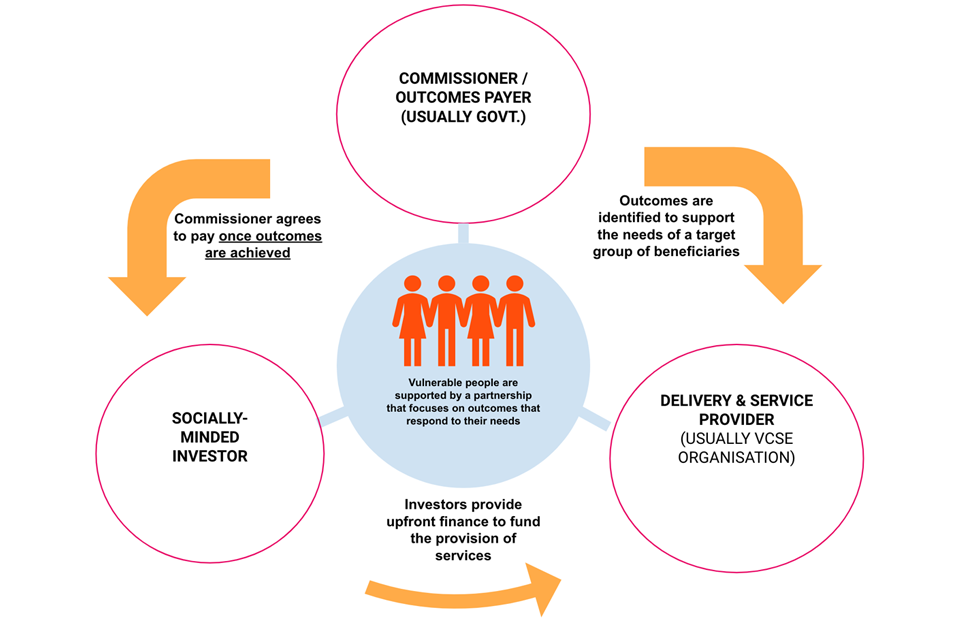
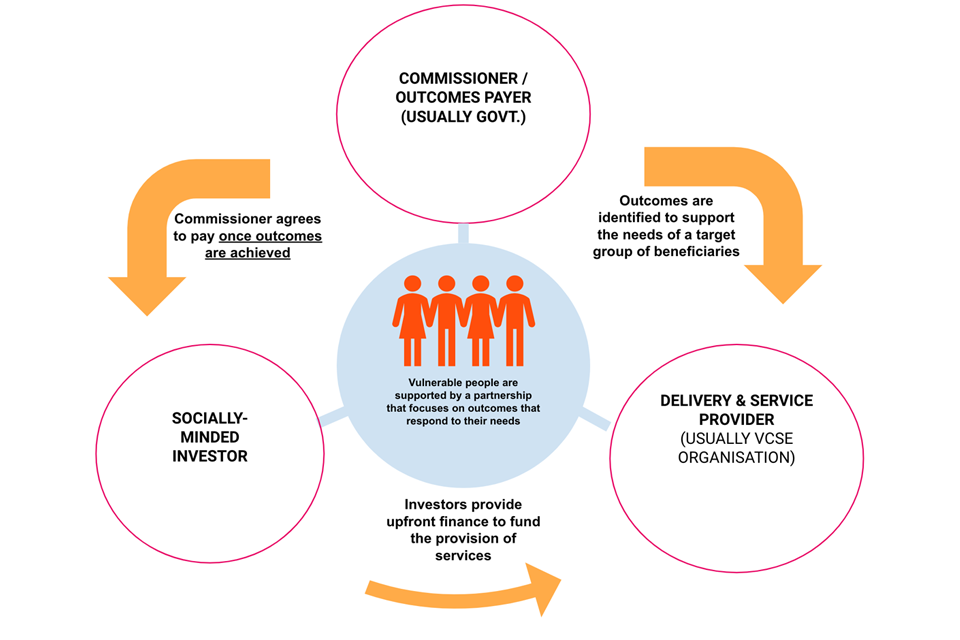
The outcomes payer is most often a statutory commissioner or group of commissioners, though private organisations have also opted to pay for outcomes in some SOPs. They identify social issues and specify measurable outcomes that must be achieved to address them. The commissioner pays for these outcomes when they are achieved.
The social investor is typically a social investment fund seeking social as well as financial returns. It provides upfront funding to finance a service designed to achieve the commissioner’s outcomes. The investment is repaid by the commissioner on the achievement of specified outcomes.
The service provider is often a social enterprise or charity organisation. It works with the target group to deliver the outcomes defined by the outcome payer. It receives payments from investors based on the achievement of specified outcomes.
Several other organisations may also be involved in a SOP partnership, including intermediaries, consultants, performance managers or evaluators.
The potential benefits of Social Outcomes Partnerships
SOPs can bring several benefits to public service delivery, including:
- fostering broad stakeholder partnerships and collaboration that bring together a range of knowledge and expertise
- enabling new interventions or programmes to be tried and greater flexibility in the delivery of interventions
- enabling a focus on prevention and early intervention which improves individual outcomes
- providing upfront capital enables local providers with a clear understanding of social issues and target populations
The potential challenges of using Social Outcomes Partnerships
Despite the benefits, commissioners should be aware that SOPs can also be complicated to establish, and require commitment and capacity to set up. They are unsuited to cases where contracts are small and setup costs cannot be justified, or when outcomes cannot be clearly measured.
Further information on the challenges and benefits of commissioning SOPs can be found in the Social Impact Bond Commissioning and Replication reportreport, (2019), undertaken by Ecorys and ATQ Consultants on behalf of DCMS.
How to decide whether a Social Outcomes Partnership is appropriate
Before embarking on the development of a SOP it is important to carefully consider the feasibility and business case for such an approach, and how it compares to alternative ways to fund the programme or intervention. Outcome payers will need to consider both the technical processes involved, and the relationships that need to be built with other partners (such as the social investors and the service providers).
In order to consider whether a SOP is feasible, an organisation should also consider:
- whether the desired outcome is clear and measurable (for example reducing re-offending)
- whether the quality of outcomes can improve (and improvements wouldn’t have happened anyway)
- whether there is a clearly defined set of service users
- whether the time and budget to develop a SOP are available (and that the contract is large enough to justify the set-up costs)
The evidence base on Social Outcomes Partnerships
The Government Outcomes Lab (GO Lab) has produced two reports summarising evidence on Social Outcome Partnerships;
- In July 2018 the GO
GovernmentOutcomes(GO)SOPs.The report found that impact bonds have the potential to overcome perennial challenges in government including the fragmentation of public services, a short term political and financial focus, and difficulty creating change. The report found that impact bonds may help to reform the public sector through facilitating collaboration, prevention and innovation. - In
Since2024, the GOpublicationLab produced ‘The evolution of Social Outcomes Partnerships in the UK:report,Distillingfurtherfifteendatayearsandof experience from Peterborough to Kirklees’ report. The report provides a comprehensive anthology that can help both those new to social social outcomes partnerships as well as those more familiar with this approach to navigate the evidence that has emerged from the practice in the UK inandtheinternationally.past fifteen years.
For further information on the evidence of SOPsSIBs from the UK and internationally, visit the GO Lab website.
Further information
SocialPublic OutcomeService Partnerships Team and the Better Futures Fund (DCMS)
The SocialPublic OutcomeService Partnerships teamTeam (previously the Centre for Social Impact Bonds) deliveredis responsible for delivering the Life Chances Fund (LCF)(LCF), between 2016 to 2025, a £70£70m million outcomes fund delivering 29 projects across England.
Outcomes Fund, launched in 2012. The team aims to share learning and insight from the delivery and evaluation of these funds with partners across national and local government. We work in partnership with a range of stakeholders, including local commissioners, service providers, academics, social investors, intermediaries and departments across government.
TheFor teammore areinformation leadingplease deliverycontact of the BetterPublic FuturesService Fund,Partnerships whichTeam willvia support up to 200,000 struggling children, young people and their families over the next 10 years.
Find more information about the Better Futures Fundpsp-team@dcms.gov.uk.
For more information please contact: BetterFutures@dcms.gov.uk
The Government Outcomes Lab
The Government Outcomes Lab (GO Lab) is a centre of academic research and practice based at the Blavatnik School of Government, University of Oxford. It was created in 2016 as a partnership between the School and the UK government (Centre for Social Impact Bonds), and is now funded by a range of organisations. GO Lab’s role is to investigate how governments can develop fruitful cross-sector partnerships to deliver greater social impact and value. GO Lab’s research explores how governments, businesses and civil society can forge effective partnerships, how such partnerships emerge, and how they can be sustained. Alongside its research, GO Lab hosts a global knowledge hub for all those interested in deepening their understanding of outcomes-based partnerships, and runs a comprehensive programme of engagement and capacity building for government policymakers and their partners in other sectors.
Key GO Lab resources for policymakers and practitioners include:
The GO Lab team can assist commissioners in local authorities and other public sector organisations across the UK, who seek guidance on key issues relating to the development and implementation of outcome-based contracts. You can get in touch with the GO Lab team at: golab@bsg.ox.ac.uk.
Further resources
- The Knowledge Box: Developing a Social Impact Bond provides guidance for organisations that are considering developing a SIB.
- Good Finance provides guidance for charities on social investment, including a SIB provider toolkit to support organisations thinking of using SIBs
- Research: Social Impact Bond Commissioning and Replication (2019)
- Cost Benefit Analysis Guidance and Cost Benefit Analysis Model
SocialThe OutcomeLife PartnershipsChances fundsFund
-
Better
(DepartmentTheFuturesLifeChances-OverviewTheLifeChancesFund(LCF)aimstohelpthosepeopleinsocietywhofacethemostsignificantbarrierstoleadinghappyandproductivelives.The£70mfundcontributestooutcomepaymentslocallyMediacommissionedsocialoutcomescontractswhichinvolvesocially-mindedinvestors.Runninguntil2025,theLCFaimstosupportover60,000individualstoachievebetterlifeoutcomesinareassuchashealth,employment,housing.TheFundissupporting29projectsupuntil2025,andismanagedbyTheNationalLotteryCommunityFundonbehalfofDCMS.TheLCFhas7primaryobjectives:IncreasethenumberandscaleofSOPsinEngland.MakeiteasierandquickertosetupaSOP.Life
GenerateChancespublicFundsector(Departmentefficienciesbydeliveringbetteroutcomes,andunderstandhowcashablesavingsareachieved.IncreasesocialinnovationandbuildaclearevidencebasewhatMediaworks.Increasetheamountofcapitalavailabletovoluntary,communitysocialenterprise(VCSE)providerstohelpthemcompeteforpublicsectorcontracts.ProvidebetterevidenceoftheeffectivenessoftheSOPmechanismandthesavingsresulting.Growthescaleofthesocialinvestmentmarket.
Refugee
TheTransitionsLCFOutcomesempowersFundcommissioners(HomeinOffice),localpart-fundedgovernmentbytofindlocally-ledplace-basedsolutionstoentrenchedsocialproblems.Indoingso,itsupportsdevelopmentofeffectivelocalpartnershipsthatarewell-placedtodeliverwhat’sreallyneeded.Note:TheLCFwasreducedto£70min2020.Thisdoesnotaffectindividualprojects’budgetsordelivery.ThegeographicalspreadofLCFprojectsTheLCFissupporting29projectsacrossEngland,70%ofwhicharecurrentlyoperatingoutsideofLondonandtheSouth-East.TheMentalHealthandEmploymentPartnership(#20)operates5LCFprojectsacrossLondonandShropshire,supportingindividualswithmentalillnessandlearningdisabilitiesintoemployment.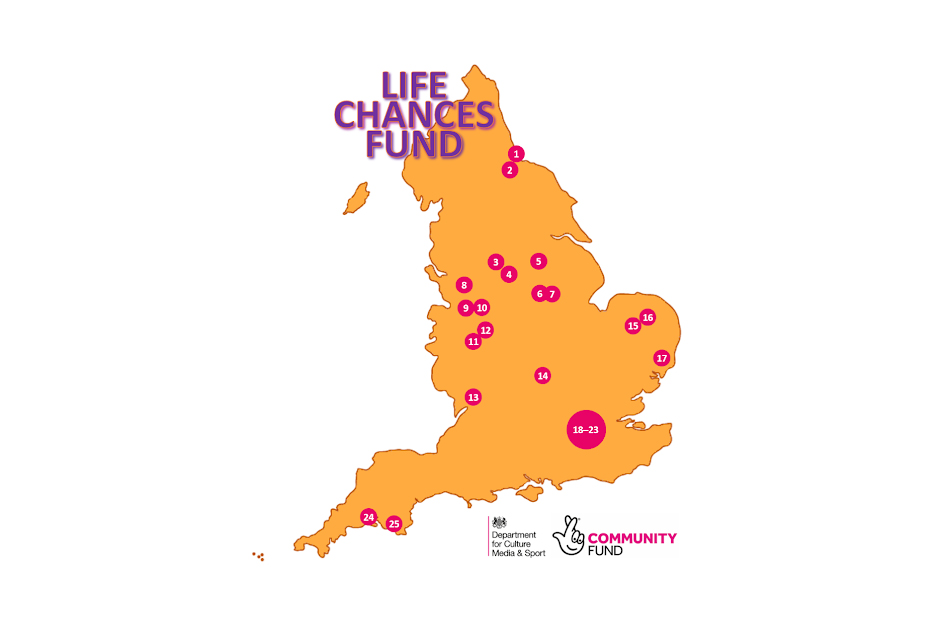
–Sunderlandand22otherEngland-widelocations-
Rough
TheSleepingSkillSIBMillFund–Durhamand7otherEngland-widelocations KirkleesBetterOutcomesPartnership(Department–YorkshirePromotingIndependence–SheffieldBigPictureLearning–DoncasterDN2Children’sServices–NottinghamFutureImpact–NottinghamFosteringBetterOutcomes–CheshireIntegratedFamilySupportService–StaffordshirePyramidProject–StaffordshireDFN-MoveForward–WestMidlands(plusLondonandKent)MidlandsRegionalPauseHub–MidlandsGloucesterPositiveBehaviourSupport–GloucestershireSocialPrescribingProject–NorthamptonshireANorfolkSIBCarersUp,–HousingNorfolkStrongerFamiliesNorfolk–NorfolkChildrenatRiskofCare–SuffolkWestLondonAlliance–LondonSingleHomelessPreventionService–LondonNorfolk-
MentalHealthandEmploymentPartnership–5projectsacrossLondonandShropshire ParentChild+–WestLondonEnhancedDementia–SIBHounslowWestProgrammeLondonZone(Department–forWestEducation)London-
Fair
CornwallChanceFrequentAttendersProgramme–Cornwall PauseProject–Plymouth
FurtherdetailsofprojectswhicharebeingfundedthroughtheLifeChancescanbefoundintheGovernmentOutcomesLab’sImpactBondDatasetLCF(CabinetlearningOfficeandevaluationTheLCFisaccompaniedbyanevaluationstrategywhichseekstoobtainevidenceontheeffectivenessoftheLCFasawhole;theimpactofindividualprojectsonoutcomesbeneficiaries;andeffectivenessofSOPsasacommissioningtool.Thefollowingevaluationreportshavealreadybeenpublished:ImplementationprocessevaluationPrimaryHousingevaluationAnandintroductoryCommunities)primaryevaluationreportAninterimsurveydatareleasefromtheprimaryevaluationFinalsurveydatareleasefromtheprimaryevaluationAnanalysisofchildren’ssocialcareLCFprojects
Youth
KirkleesEngagementBetterFundOutcomesPartnershipFirstinterimevaluationoftheKirkleesLCFprojectSecond(DepartmentinterimforevaluationWorkofandofPensions)theKirkleesLCFprojectFinalevaluationofoftheKirkleesLCFproject
Innovation
MentalFundHealthandEmploymentPartnershipFirstinterimevaluationoftheMentalHealthandEmploymentPartnershipLCFprojectFinalevaluationoftheMentalHealthandEmploymentPartnershipLCFproject
TheGovernmentOutcomes(GO)Labisthegovernment’sprimaryevaluationpartnerfortheLCF.Seefurtherinformationabouttheirwork,aswellasLCFprojectcasestudiesandachievementstodateGOLab’sevaluationworkisbeingsupplementedbyindividualevaluationscommissionedbytheLCFprojectsthemselves.ReadthereportspublishedsofarfromtheLCFprojects’ownevaluationsOtherUKgovernmentoutcomesfundssupportingSOPsTheLifeChancesFundhasbuiltonlearningfromtheSocialOutcomesFundand -
Social
theRefugeeTransitions(HomeOffice),part-fundedLifeChancesFund theRoughSleepingSIBFund(DepartmentforLevellingUp,HousingandCommunities)theCareLeaversSIBProgramme(DepartmentforEducation)theFairChanceFund(CabinettheNationalDepartmentLotteryforCommunityLevellingFund)Up,HousingandCommunities)theYouthEngagementFund(DepartmentforWorkandPensions)theInnovationFund(DepartmentforWorkandPensions)
Other UK government SOP funds include:
Further detail on UK government outcomes funds for impact bonds can be found on the the Government Outcomes Lab’s website.website.
The Government Outcomes Lab manages an an Impact Bond Dataset which which includes information on SOPs at various stages of development in the UK and around the world.
Updates to this page
-
This page has been retitled 'Social Outcome Partnerships'. Information about the Life Chances Fund is now on a separate GOV.UK page.
-
Links to new evaluation reports have been added
-
We have updated the page to include links to two further published outputs from the evaluation of the Life Chances Fund.
-
A link to the process evaluation for the Life Changes Fund report has been added to the LCF learning and evaluation section.
-
Updated page title and summary to reflect page includes info on the Life Chances Fund.
-
Page update.
-
Updated guidance and information about support to develop a Social Impact Bond.
-
Added link to new guidance on the template contract for social impact bonds and payment by results.
-
Added the Social Outcome Fund's Expression of Interest application form for SIB funding
-
First published.
Update history
2026-03-05 15:00
This page has been retitled ‘Social Outcome Partnerships’. Information about the Life Chances Fund is now on a separate GOV.UK page.
2025-09-02 11:48
Links to new evaluation reports have been added