Patent factsheet: Publication
Find out about the first publication of your patent application and what it means for your future rights.
This guide includes basic information about the first publication of your patent application, the known as the ‘A’ publication. It explains the form in which your application is published, what additional information is published at this stage, and its significance on future rights.
This guide does not cover second or ‘B’ publication, which takes place after a patent is granted.
What does ‘A’ publication mean?
At ‘A’ publication, your specification is made available to the general public and to specialist libraries and other patent offices around the world. The specification is published on the Intellectual Property Office (IPO) website and is made freely available to view and download. The application is laid open to public inspection and the fact of publication is advertised in the IPO online Patents Journal. It is therefore at this stage that all details of your invention are seen by competitors.
The act of publication gives notice that you are seeking a patent and warns the public of the monopoly sought, via the claims.
To prevent your application being published, you will need to withdraw it before the date when preparations for publication are complete, also called the PPC date. An indication of this date, and an explanation of how to withdraw, will be provided in the cover letter of your search report. A few days before this date, we write to you to give the exact date when preparations for publication will be complete and provide you with a publication number and date of publication. By then it may be too late to prevent publication of your application. If you withdraw your application it will not continue and so you will not get a patent granted.
Your name and address will appear on the front page of the published application. Upon publication these details will also appear in our records and in our online Patents Journal, both of which are available to the public on our website and can be permanently searched using most standard search engines. If you do not want your home address published, please give us a different address where you can be contacted, such as a business address or a PO Box address.
Please do not add any personal information to your description, claims or drawings when you file an application with us, as this information will become available to the public when your application is published.
What is published?
The published ‘A’ document includes:
- the description of your invention as originally filed
- any drawings filed with your application (as amended if necessary)
- the first set of claims filed, and the last set of any amended claims received before publication
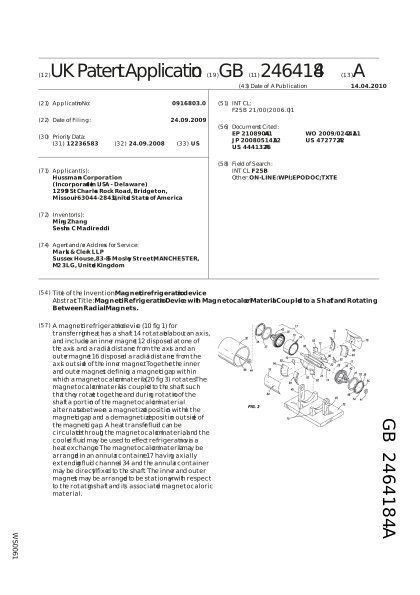
- the front page with the abstract (which may have been amended by the examiner), an illustrative drawing, bibliographic details and a list of documents cited on the search report
- a copy of the search report
In addition, at ‘A’ publication, all the correspondence on file between you and the Intellectual Property Office becomes available to the public. It is not included in the ‘A’ document, but may be inspected by any member of the public who asks to see it.
What are the reference codes on the front page of the ‘A’ document?
These are standard codes used by all countries that are members of the World Intellectual Property Organisation (WIPO).
They include:
- 11 - patent number given to the published document
- 12 - description of document
- 13 - code letter applied to type of publication
- 19 - standard two letter country code
- 21 - reference number (year-related) given to the application at filing by the IPO
- 22 - date the application was filed with the IPO
- 30 - information about the earliest date that the application carries. 31 is the priority application number, 32 is the date of that application and 33 is the priority country
- 43 - date on which the application is first published by the IPO
- 51 - the International Patent Classification Code applied by the IPO to this application, and the edition used
- 54 - title of the invention and abstract title
- 56 - list of prior art documents given in the search report
- 57 - abstract of the invention
- 58 - document collections searched by the UK examiner
- 71 - persons or corporate body applying for the patent
Not all of these types of content will appear on every ‘A’ published document. An example image is given below with example content for some of these codes.
When is my application published?
Unless you’ve requested accelerated publication, ‘A’ publication will not generally take place until about 18 months from the earliest date of your application (either the filing date, or the priority date if claiming priority from an earlier application).
In the example given below, the application was filed on 24 September 2009 but has an earlier priority date of 24 September 2008. The publication date is 14 April 2010, approximately 18 months after the priority date.
Have I any patent rights?
At this ‘A’ publication stage you have no patent protection. A patent is only granted when an application meets the requirements of the Patents Act and Rules and this can only be established by substantive examination (see below). If a patent is eventually granted, you may be able to take action against infringements which have occurred after your ‘A’ publication date, but not for the period between filing and ‘A’ publication.
What do I do next?
You may decide that you do not wish to continue with your application, for example if the documents cited in the search report indicate that your invention is not new.
However, if you decide to continue, you have 6 months from the date of ‘A’ publication to request substantive examination of your application (unless you have done so already) by filing Patents Form 10 with fee.
Example front page of an ‘A’ document
The image below shows the front page of the ‘A’ document for UK patent number GB 2464184 as an example, including some of the types of content described in the Reference codes section above. The page also includes an image of the invention, which is a magnetic refrigeration device.
Getting help
It’s a good idea to seek professional assistance when preparing your patent application, as you’re more likely to succeed in getting a patent granted if you do.
You can also contact the IPO on 0300 300 2000 (local call rate) or visit our website. We are keen to help all our customers as much as possible, but regret that we cannot help with the commercial exploitation of your invention.
This factsheet is not intended to be comprehensive and necessarily omits details which may be relevant in particular circumstances.