Zika virus: sample testing advice
Guidance on who to test for Zika virus infection and which samples to collect.
This guidance on the laboratory diagnosis of Zika virus infection is intended for healthcare professionals in the UK. Patients concerned about possible Zika virus infection should consult an appropriate healthcare professional, for example their GP, in the first instance.
Testing asymptomatic returned travellers
Zika virus testing is not currently available for individuals who have had no symptoms suggestive of Zika infection, including private patients. Such individuals include:
- asymptomatic pregnant women who have travelled from countries or areas with risk of Zika virus transmission
- asymptomatic returned male travellers whose partners are currently pregnant
- asymptomatic returned male and female travellers who are trying to conceive
- asymptomatic returned male and female travellers who would like to be tested for family planning reasons
These individuals should be advised to follow UKHSA guidance on prevention of pregnancy and avoidance of sexual transmission as appropriate, rather than pay for private Zika virus tests that may not be fully validated for testing people who don’t have symptoms.
Investigation of patients with current or previous symptoms
Clinicians should consider Zika virus infection for:
- any patient who has, or has had, a rash illness or other symptoms suggestive of Zika virus infection, that began whilst in any country with risk of Zika virus transmission, or within 2 weeks of leaving that country
- any patient presenting with symptoms suggestive of Zika virus infection apparently due to sexual transmission; that is, there is no history of travel to a country or area with a risk of Zika virus transmission or the symptoms began more than 2 weeks after travel to a a risk country, and their male sexual partner had travelled within the last 3 months from a country or area with risk of Zika virus transmission
When assessing patients presenting with acute symptoms, doctors should also consider other travel-associated infections in the differential diagnosis, including:
- dengue and chikungunya virus infections
- malaria
- common infections not associated with travel, for example, influenza
Note that symptoms such as coryza, cough and/or sore throat suggest upper respiratory tract infection and not Zika virus infection.
Completion of RIPL Request Forms
Zika virus infection is not a notifiable disease. Therefore, there is no statutory requirement to test for this infection if the test result will have no impact on clinical management.
Diagnostic samples must be submitted with a completed request form providing details of the patient’s travel history, symptoms and, if relevant, pregnancy. There are 2 possible request forms available: a specific Zika virus request form and a standard RIPL request form.
The appropriate request form should be selected using the algorithm below. For any returning traveller who is unwell with an acute febrile illness or who requires admission to hospital, provided detailed information about symptoms and travel to Central/South America, the Caribbean, South/Southeast Asia or Sub-Saharan Africa is included, RIPL will perform Zika virus testing as part of a geographic panel of PCR and serology tests, without Zika virus having to be specifically requested.
Ideally, the appropriate request form should be printed out and completed (except for the sender’s information at the top) by the clinician who sees the patient. Send the request to the local laboratory with the clinical samples along with a local laboratory request form, whether this is paper or electronic.
The local laboratory should complete the sender’s information on the request form and then forward the completed form and samples to RIPL. However, local arrangements may vary, so clinicians are advised to liaise with their local laboratory first, before sending samples.
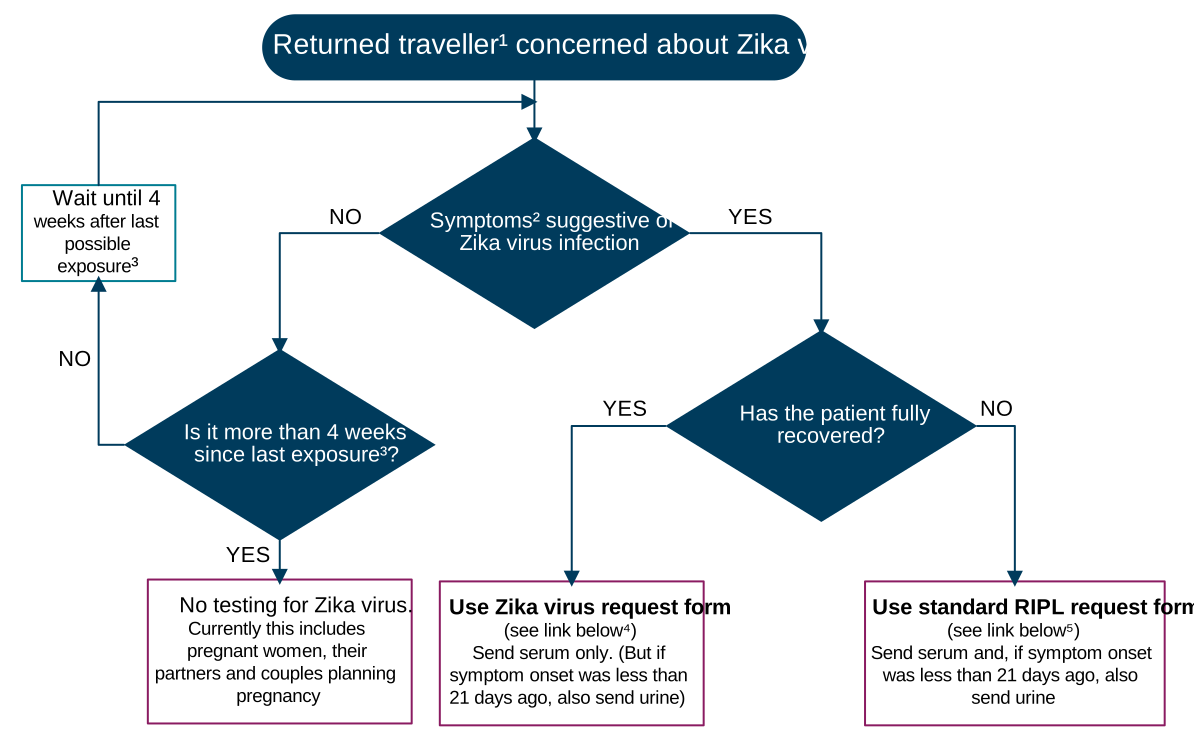
Notes
- Zika virus infection should also be considered in any non-traveller whose male sexual partner has travelled within the last 3 months from a country or area with risk of Zika virus transmission, particularly if this partner is male.
- Symptoms suggestive of Zika virus infection that began whilst in a country or area with risk of Zika virus transmission or within 2 weeks of leaving or within 2 weeks of last possible sexual exposure.
- Last possible exposure is defined as the later of either the date of leaving a country or area with risk for Zika virus transmission, or the date on which last unprotected sexual contact with a potentially infectious partner took place. 4.See the Zika virus testing request form. An acute serum sample should be obtained and submitted promptly. However, a follow-up sample may be required subsequently.
- Refer to the:
Standard sample types for routine Zika virus testing
Where serum is indicated in the algorithm above, clinicians should submit a clotted blood sample (“plain” or “serum separator gel” tube) to their local laboratory. The local laboratory should submit a minimum of 0.8 mL serum to RIPL.
Please do not submit EDTA whole blood or plasma samples in addition to serum as these sample types are not required for routine Zika virus testing. Such unnecessary samples may be stored without testing, incurring a sample handling and storage fee.
Where urine is indicated in the algorithm above, clinicians should submit urine (5 mL is sufficient, minimum volume 1 mL) in a Universal tube (without any preservative) to their local laboratory for forwarding to RIPL.
Inappropriate samples (such as unnecessary EDTA plasma, or urine samples taken more than 21 days after symptom onset) and those submitted with inadequate clinical information will usually be stored without testing. The charge for this sample handling and storage is as indicated in the RIPL user manual.
Other samples (including obstetric and neonatal) suitable for Zika virus testing
Semen
Semen can be tested for Zika virus RNA, but only if prior arrangement with RIPL has been made. Returned male travellers with current or previous symptoms should be investigated as indicated in the algorithm in the first instance.
A local infection specialist or senior member of the obstetric team must contact RIPL to discuss the case, before sending samples in any of the following scenarios:
Fetal abnormality (with or without amniocentesis)
Any case where an abnormal fetal ultrasound scan in a returned pregnant traveller is being investigated: maternal blood samples will be required for testing in addition to any amniotic fluid.
Termination of pregnancy
Any case where termination of pregnancy is performed for known or presumptive congenital Zika virus infection: appropriate samples for diagnostic testing will include maternal serum, placenta, cord tissue and fetal (brain) tissue.
Miscarriage or stillbirth
Any case of miscarriage or stillbirth in a woman with known or possible Zika infection (having travelled to a country or area with risk of Zika virus transmission earlier in the pregnancy): appropriate samples for diagnostic testing will include maternal serum, placenta, cord tissue and fetal (brain) tissue.
Anticipated live delivery following known maternal Zika virus infection
The pregnancy of any woman with laboratory-diagnosed Zika virus infection should be followed up in a Fetal Medicine Unit.
Whether antenatal fetal ultrasound scans have been normal or not, contact RIPL a few weeks before the anticipated live delivery to make arrangements to submit appropriate diagnostic samples for Zika virus testing. These will include placenta, cord tissue, neonatal serum, contemporaneous maternal serum, and neonatal urine. Neonatal CSF will only be appropriate if a lumbar puncture is clinically indicated.
Live delivery following undiagnosed Zika virus-like maternal illness
Any neonate delivered to a woman who travelled to a country or area with risk of Zika virus transmission earlier in the pregnancy and who had an illness that might have been Zika virus infection but who was not subsequently tested for Zika virus antibodies (even if Zika virus PCR tests performed in the acute phase were negative): appropriate samples for diagnostic testing will be advised on a case-by-case basis.
Note that no Zika virus testing will be required for a normal neonate born to a woman who travelled to a country or area with risk of Zika virus transmission earlier in her pregnancy but who either:
- had a negative Zika virus antibody test 4 weeks or more after her last possible exposure to Zika virus, or
- had no symptoms suggestive of Zika virus infection during travel or within 2 weeks of leaving and who did not have an antenatal Zika virus antibody test performed; if maternal testing for Zika virus antibodies was not performed antenatally, it is not necessary to perform it postnatally
Zika virus laboratory tests available at RIPL
Diagnostic testing for Zika virus is performed at the Rare and Imported Pathogens Laboratory using both molecular and serological methods. Diagnostic samples must be submitted with a completed request form providing details of the patient’s travel history, symptoms and, if relevant, pregnancy. Positive results are always telephoned to the referring laboratory and clinical significance discussed.
Molecular testing for detection of Zika virus RNA
- Zika virus PCR is routinely performed on serum and urine samples. Testing of semen, amniotic fluid and tissue such as placenta or umbilical cord (see Other samples suitable for Zika virus testing) by PCR may also be performed in specific circumstances after discussion with the clinical team at RIPL.
- Zika virus PCRs are performed daily, Monday to Friday, at RIPL and results are reported within 5 working days of sample receipt
Serological testing for the detection of Zika virus antibodies
- tests for Zika virus IgG and IgM are performed on serum
- Zika virus antibody tests are performed daily, Monday to Friday, at RIPL and results are reported within 5 working days of sample receipt
Interpretation of Zika virus test results
Zika virus results are reviewed by the clinical team at RIPL, and an interpretative report will be included for any positive results, including whether further samples may be required to aid diagnosis.
The Imported Fever Service can also be contacted to discuss any results and for clinical advice. Results which confirm Zika virus infection (such as a PCR positive result) will be telephoned to the referring laboratory.
Contact details and testing laboratory address
Main RIPL number
01980 612 348. Service available 9am to 5pm, Monday to Friday.
Imported Fever Service
0844 77 88 990. This service is available, 24 hours a day, 7 days a week, for urgent discussion of any acutely unwell febrile patient in whom severe travel-associated infection is suspected. Please do not use this number for routine Zika virus infection enquiries.
Testing laboratory address
Rare and Imported Pathogens Laboratory
PHE Porton
Manor Farm Road
Porton Down
Wiltshire
SP4 0JG
DX address
DX 6930400, Salisbury 92 SP
Updates to this page
-
Changed information to be up-to-date.
-
Updated guidance on managing asymptomic patients, and investigating patients with current or previous symptoms.
-
Updated guidance on Zika testing.
-
Updated in line with changes in travel and sexual transmission advice and revised Zika virus risk ratings, and changes to sample submission process.
-
Clarification of testing arrangements.
-
Revised substantially to reflect the use of serological testing.
-
Updated symptom list.
-
Updated Zika testing advice.
-
First published.