Community engagement approach for health protection
This resource sets out UKHSA’s co‑created approach to community engagement for health protection.
Community engagement approach for health protection helps professionals define what they mean by ‘engagement’, so they can manage expectations; assess whether engagement is inclusive, effective, equitable and consistent; and build trust between communities and the health system to strengthen health protection.
What is community engagement?
‘Community Engagement’ is a process of developing relationships that enables stakeholders to work together to develop more efficient and effective solutions that address health protection risk and contribute to improved health outcomes (1). There are multiple types of engagement, and each have their place in health protection work. However, it is important to be clear about what type of engagement is taking place to manage expectations of communities and health system partners and inform the mechanisms and approaches that should be used.
Why does community engagement matter?
Community engagement is a key approach to improving health and reducing inequalities (2) and is essential to health protection. Effective community engagement builds trusted relationships so policies and interventions are designed, delivered and evaluated in ways that work for communities. This supports more equitable, responsive management of health protection risks and helps reduce inequalities in outcomes.
How was the approach developed?
UKHSA worked with people with lived experience of social exclusion and the voluntary, community and social enterprise sector to consult on what ‘good engagement’ looks like. This highlighted the need to clearly define ‘engagement’ and set standards for what ‘good’ looks like.
UKHSA then co‑created a community engagement approach for health protection with people with lived experience. This includes a community engagement model and a planning tool. See Annex A for more on the methodology.
The engagement model
The engagement tool can be used by anyone involved in designing, delivering or evaluating health protection interventions, and may also be useful beyond this. The model helps practitioners identify the type of engagement taking place and sets mutual expectations through the ‘public promise’.
Practitioners should consider if there are opportunities to strengthen the partnership offer. For example, if the approach is to ‘consult’, practitioners should identify opportunities to include elements of co-production, such as co-producing communication materials or the methodology for a consultation process. Where communities are ‘involved’ or where there is ‘co-production’, practitioners should plan how meaningful feedback can be provided to the communities engaged.
Types of engagement approaches
Engagement is a spectrum, and ranges from organisation led to collaborative to community led. The cocreated engagement model has been adapted from the International Association for Public Participation (3).
The infographic provides an overview of the types of engagement. You can read the text version below. The image is available by contacting healthequity.queries@ukhsa.gov.uk.
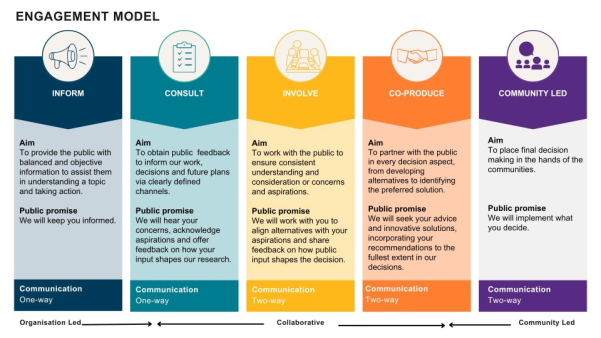
Inform
- Aim: to provide the pubic with balanced and objective information to assist them in understanding a topic and taking action
- Public promise: we will keep you informed
- Communication: one way (organisation to community)
Consult
- Aim: to obtain public feedback to inform our work, decisions and future plans via clearly defined channels
- Public promise: we will hear your concerns, acknowledge your aspirations and offer feedback on how your input shapes our research
- Communication: one way (organisation to community)
Involve
- Aim: to work with the public to ensure consistent understanding and considerations or concerns and aspirations
- Public promise: we will work with you to align alternatives with your aspirations and share feedback on how public input shapes the decision
- Communication: two-way
Co-produce
- Aim: to partner with the public in every decision aspect, from developing alternatives to identifying the preferred solution
- Public promise: we will seek your advice and innovative solutions, fully incorporating your recommendations in our decisions
- Communication: two-way
Community-Led
- Aim: to place final decision making in the hands of communities
- Public promise: we will implement what you decide
- Communication: two way (with a focus on community to organisation)
The planning tool
The planning tool provides further guidance to practitioners on how to deliver engagement in an equitable and effective way. This establishes a set of standards for community engagement, that can be used regardless of the engagement approach.
The tool can be used to inform programme planning around engagement and identify the most effective approaches that build on existing evidence and insights. It can be used once it is identified that engagement is required and can continue to be updated and considered as plans develop.
It can inform methodology, outputs, and ensure that engagement to deliver public health interventions support broader outcomes around trust and community resilience.
The infographic provides an overview of standards for good engagement. You can read the text version below. The image is available by contacting healthequity.queries@ukhsa.gov.uk.
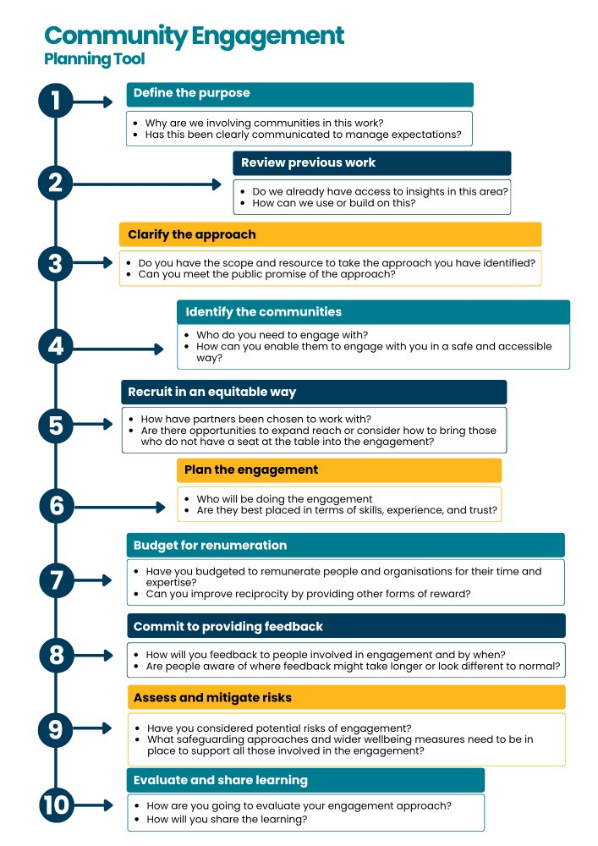
The Community Engagement Standards
1. Define the purpose
Why it matters: Helps manage expectations, build trust, and avoid tokenism.
- why is community engagement appropriate for this work?
- has the purpose been clearly communicated to manage expectations?
2. Review previous work
Why it matters: Prevents duplication, consultation fatigue, and wasted resources.
- are there insights on this topic, population or setting that can be used or built on?
3. Clarify the approach
Why it matters: Ensures clarity, appropriate expectations, and trust
- is there the scope and resource to adopt the approach identified?
- can this work meet the public promise outlined in the engagement approach?
4. Identify the communities
Why it matters: Promotes inclusivity, enables an effective approach and safeguards against exclusion or harm.
- apply the CORE20PLUS framework to identify potential inequalities, and use this to identify communities that should be prioritised in engagement?
- what approaches and considerations need to be made to enable them to engage in a safe, accessible and effective way?
5. Recruit in an equitable way
Why it matters: Builds trust and ensures participants understand their role.
- how have partners been chosen to work with?
- are there opportunities to expand reach or consider how to bring those who do not have a seat at the table into the engagement?
6. Plan the engagement
Why it matters: Sensitive topics require skilled, empathetic and trusted facilitators.
- who from the organisation will lead the engagement? Are they best placed when considering skills, experience and trust?
- are others in the organisation aware of the engagement and bought in to listening and acting on feedback?
7. Budget for renumeration
Why it matters: Shows we value contributions and supports meaningful involvement.
- has the organisation budgeted to renumerate individuals and organisations for their time?
- what other ways can an individual or organisation’s expertise and time be valued? For example, access to training, expertise, or reference letters
8. Commit to providing feedback
Why it matters: Timely feedback reinforces trust and shows impact.
- how will those involved in the engagement receive feedback and by when?
- are those involved in the engagement aware of any barriers or timeframes that may result in feedback taking longer or looking differently to normal?
9. Assess and mitigate risks
Why it matters: Protects participants and relationships with communities.
- are there any risks to the engagement in terms of the project itself, and the potential implications for long term outcomes, including trust?
- what safeguarding approaches and wider wellbeing measures need to be in place to support all those involved in the engagement?
10. Evaluate and share learning
Why it matters: Demonstrates impact, supports learning, and avoids duplication.
- how will the engagement approach be evaluated?
- how will the learning be shared across the organisation or wider health system for others to learn from?
Annex A: Methodology
UKHSA commissioned EPIC, a social research and involvement collective to carry out consultations with people who experience social exclusion, to understand what good engagement and equitable partnership means to them. It involved 317 people, both those with lived experience and the voluntary sector organisations who support them.
Whilst our research was with inclusion health groups and the voluntary sector organisations that support them, the intersectionality of participants has informed a model of equitable engagement that can apply to all communities, specifically those who experience health inequalities.
During this research, EPIC engaged with communities in a range of ways and aimed to take a whole system approach via:
1. Consultation with people with lived experience of social exclusion
EPIC worked with the voluntary and community sector to engage with communities via surveys and focus group discussions. 188 people took part in the lived experience surveys, and 63 took part in the focus group discussions to understand what ‘good engagement’ looks like in health protection.
2. Consultation with representatives from voluntary, community and social enterprise (VCSE) organisations
EPIC engaged with VCSEs who work with inclusion health groups via surveys and an online workshop. 41 individuals from 27 VCSE organisations participated in the VCSE survey, and 7 participants attended a focus group.
3. Co-production sessions with people with lived experience of social exclusion
EPIC supported the facilitation of a three-hour cocreation session with individuals with lived experience of social exclusion. This session enabled UKHSA to explore, in partnership with people with lived experience, how to integrate draft consultation findings into an engagement approach for health protection.
4. Oversight and steer by the Health Equity Advisory Committee
UKHSA and EPIC piloted a lived experience Health Equity Advisory Committee to shape and steer the work. UKHSA and EPIC facilitated four committee meetings with representatives from UKHSA, 9 people with lived experience of social exclusion and 3 VCSE partners who could provide pre and post-support to these individuals. The committee played a leading role in the development of the approach, and ensured insights from consultations were reflected in its coproduction.
Acknowledgements
Donna Gibson and Lucy Wainwright, EPIC Consultancy.
The Health Equity Advisory Committee and Coproduction Groups including Prison Reform Trust, Migrant Help and Turning Tides.
Hayley Lightfoot.
UKHSA Health Equity and Inclusion Health.