Martyn Oliver's speech at the National Day Nurseries Association
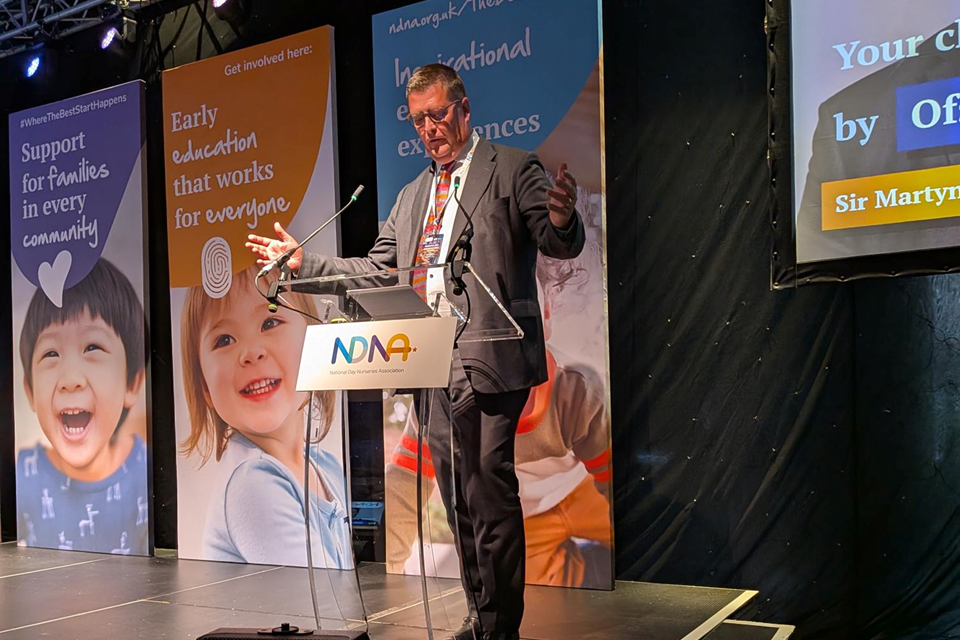
Ofsted’s Chief Inspector, Sir Martyn Oliver, spoke at the National Day Nurseries Association (NDNA) Conference 2026 in Liverpool.
Introduction
Hello everyone, it’s great to be here with you all in Liverpool, right on the docks.
This is my first time speaking at the NDNA Conference, so thank you for having me. I’ve been looking forward to being in a room with you all.
In particular that’s because I know it’s a very challenging time for this sector. You only have to look at the news to see that. To see that the very safety of nurseries is, I am afraid, being questioned.
Of course, it’s something that we have been talking about at Ofsted as the inspectorate and regulator, and I know it will be on your minds, too. I think it’s a good time for us to reflect together.
So today I will talk about what Ofsted is doing to help and what you can do too.
A better, safer system
We all know that the vast majority of nurseries are doing a very good, and excellent, job. Up and down the country, dedicated people like those of you in this room are giving children the very best start in life.
Making sure they’re happy, safe and cared for. Leading them through play as well as explicit learning. And building good relationships with the parents who drop them off and pick them up every day.
I’ve seen it myself on visits to Busy Bees in York and Childbase’s settings in Milton Keynes! I have witnessed the thought, care, training and professionalism that guide everything you do.
And I also saw it just this week, just 2 days ago, at the Learning Tree Nursery and Kids Club near Thirsk, in North Yorkshire. This nursery had not long ago been inspected under the new framework and it got ‘strong standard’ across all areas. It was a pleasure to see just how strong their practice is.
It was also wonderful to learn how it operates as a community charity and that sense of being at the heart of its community was perhaps my biggest takeaway from the visit.
Either that – or the 2 tortoises who were brought in for the day and had everyone’s attention!
I was also pleased to see that they – the nursery, not the tortoises! – were using their QR code on the banner outside to link to the report card online. You can go and read it, too.
But as I said at the start, the awful news headlines show us that the picture isn’t so positive at every setting everywhere.
We have seen some shocking and, frankly, disturbing incidents of abuse and neglect. Incidents where children have faced the ultimate harm.
It has been sickening, sickening, to read about these cases where children who are meant to be being kept safe are instead being let down. To read about and to see first-hand the pain their families are going through.
One child coming to harm is one too many. Several children coming to harm is deeply, deeply unacceptable. I know we all feel the same about that.
None of us want to see these sorts of failings.
None of us want to see headlines asking ‘are nurseries safe?’.
But we cannot deny that, in a very small number of nurseries, the answer to that question has been a resounding and devastating ‘no’.
It is therefore incumbent on all of us to make settings as safe as possible for children. To collectively point out, share and learn from good practice, so that we build a better, safer system that is as nurturing as it can be – and a system, certainly, where no child comes to harm. I know that is what every single person in this room strives for every single day.
Parents tell us that when a setting is registered with Ofsted it means something. When we say a setting is safe, they listen. When they place their baby or child in a setting, they are also placing their trust in that setting.
So we must talk frankly about what is needed to make sure that trust is never, ever misplaced.
What can you do?
So what am I asking of you?
If you run a large group of settings, please think about how you are ensuring oversight of each individual setting. I urge you to think carefully about your nominated individuals and what you’re doing to maintain the same scrutiny as if you were in charge of just one nursery.
And you must always notify us when a significant event happens. When we receive absolutely no notifications from a setting, of course that might mean that nothing significant is happening. That’s great! I’m not talking here about minor events that we explain online, like where children fall over, or they get a graze.
But was a child left unsupervised? Did an unauthorised person access the premises? If so, we need to know. We really need to know.
And sometimes we have to ask, are nurseries choosing not to tell us?
That is illegal.
We are looking at patterns of notification and non-notification, and we will be cracking down on this.
What are we doing?
We are turning that lens back on ourselves too, looking really closely at many areas of our work – from the point at which we receive a notification to the way we respond and the action we then take.
We are asking ‘are we doing this in the best possible way?’ and making changes off the back of that.
One change is that we will be inspecting settings more frequently. In line with our shared commitment with the Department for Education to give parents more up-to-date information and reassurance, we’ve introduced a new 4-year inspection cycle. When providers register, they will now have their first inspection within 18 months, with their next inspections every 4 years, or sooner if we see risks.
It means we’ll have a more up-to-date picture of how settings are doing and gives us more opportunities to spot where things aren’t right.
We also have an annual cycle of updating our toolkits in time for September every year. This year, that means we are welcoming the Department for Education’s changes to the EYFS and we’re supporting that by adding even more detail on safer sleeping and safer eating practices to our toolkits.
Inspectors will now, from September, look at eating and sleeping practices on every inspection, where this is appropriate. Every inspection will give closer attention to how these practices are understood and overseen in day-to-day care. And where practice falls short, we will always reflect that in the grade we give.
You also heard the announcement earlier today that Ofsted will become the designated whistleblowing body for early years provision. We welcome this idea and we really look forward to conversations with the Department for Education about how we move this forward to ensure that people with concerns about wrongdoing not only know how and when to contact us, but also get the protected status that whistleblowing affords.
We also can and do inspect and make regulatory visits without notice – unannounced visits. It’s because we want to see a real day at a setting – good practice that’s happening day in, day out, regardless of whether Ofsted are visiting. And we will follow up on any regulatory concerns, including where we may have concerns about patterns of no notifications.
We have really clear guidance for inspectors on what they should consider when deciding whether to give notice before an inspection or a regulatory visit.
We look at whether any risk to children will increase if we announce the inspection or visit. We consider whether leaders are acting with integrity – for example, are they likely to take children with SEND off site for the day if they know Ofsted are coming? And when there are concerns, for example about whether settings are adhering to ratios, then yes we will carry out a no notice inspection or visit.
Discerning and differentiating
All those actions and changes are vital to collectively keep doing all we can to improve things in the interests of babies and children.
This is a sector that, under the previous system, was rated at 98% ‘good’ and ‘outstanding’.
As the inspectorate and the regulator we look at that number, and we look at ourselves and our ways of working. When we say that 98% of settings have nothing to improve… well, it’s something we need to think very seriously about.
So what does that mean?
It means, I think, a single-word judgement of ‘good’ is no longer good enough.
We have to be able to differentiate – and the new system, with its 5 grades across multiple evaluation areas, allows us to do that.
Our renewed inspection framework is also based around the requirements of the EYFS. As you all know, these are the requirements set out by the Department for Education, that you as providers must meet to ensure our youngest children are getting high-quality care and education.
We are being more discerning – offering nuance when we award grades and being as rigorous as we can be on every single inspection we do.
I am sure that everyone in this room would expect that, because everyone here absolutely has high standards for the children you care for.
What we’re seeing and exceptional practice
So what grades are we seeing so far?
Well, first it’s important to say that we will not duck our responsibility to identify problems when we see them. Under our new grading system, we have given 234 ‘urgent improvement’ grades.
We’ve given that grade where we’ve seen issues around safer eating, concerns around hygiene, safeguarding policies either not being in place or not being followed, and staff not understanding what children already know and what they should be taught next.
Where we do give ‘urgent improvement’ as a grade, we will typically inspect those settings again within 6 months to make absolutely sure that they are taking this grade seriously and acting swiftly to improve.
In more positive news, we are seeing many ‘expected standard’ grades, and some settings – like The Learning Tree Nursery I visited this week – with ‘strong standard’ across the board.
Some are broadly meeting the ‘expected standard’ grade but with a ‘needs attention’ grade in there too that signals something to work on – whether that’s managing behaviour or making sure that every child, including the quieter ones, receive high-quality interactions.
Similarly we are finding some very positive examples of practice that we point out in your report cards. Perhaps that’s establishing routines with the children, or adapting your activities to be appropriate for every child in the room.
And while ‘exceptional’ is a high bar, it absolutely is a grade that you can achieve. In that spirit, I want to give credit to some of those who have done exactly that. Some of the best provision in the country, who we expect to share their practice.
We inspected Parklanes Wykeham Childcare in Essex, whose inclusion offer was ‘exceptional’. Staff at the setting use their expert knowledge to hold external partners to account so that children receive an abundance of support. This seamless work with other settings, including schools, helps children transition through their education. Leaders’ work in the community and beyond is also leading to system-wide improvement.
We inspected Ventnor Community Early Years Centre on the Isle of Wight, where inclusion and leadership and governance were ‘exceptional’. Leaders have established and nurtured exemplary collaborative relationships with outside agencies, as well as with families. Parents are really positive about the strength of these partnerships which allow their children to thrive.
And we inspected Future Einsteins in Wakefield, who were also found to be ‘exceptional’ in their inclusion offer and leadership and governance. Inspectors found leaders who regularly and rigorously review their own practice through data collection, peer observation, audits, and engagement with parents, children and professionals.
That regular reflection is brilliant and it’s exactly what we hope for the wider sector – looking at your practice and seeing where it could be better – always striving forward.
All of these nurseries are either private, voluntary or independent – none of these are based at a school.
I want to be clear that we cannot do like-for-like comparisons. The early years evaluation area in a school also captures reception – which, in cases where there is no nursery in a school, can mean there are no children there under the age of 4.
But I can absolutely assure you that we are awarding ‘exceptional’ grades across both sectors. And we will continue to point out exceptional practice wherever we find it!
I hope you find this reassuring and I encourage you to go online and read the full reports for those settings I mentioned: Parklanes Wykeham Childcare, Ventnor Community Early Years Centre and Future Einsteins. If you can’t remember the names, you can find this speech on GOV.UK from next week.
As well as publishing report cards, we publish everything relating to inspection online: toolkits, inspector training, FAQs, commentaries, blogs and more. So come to us directly. Use our resources – use the real source material. It is free. You do not need to pay for this information. And you can ask us at our webinars and you can ask me when I finish speaking in just a moment.
Wrap-up
I know I have delivered some tough messages today.
But it’s because when things go wrong in this sector, babies and children suffer.
As a profession, you need Ofsted to do its job as we not only protect children, but we also protect the reputation of this profession by having high standards.
When parents drop their child off at nursery, they trust that they will be safe and cared for. We cannot let them down – we cannot let that trust be unfounded.
As I said earlier, one child coming to harm is one too many. I know every one of us here believes that, and that we are all committed to making sure we do not see more cases like those that have been in the news.
I will reiterate that the vast, vast majority of settings are safe places. Places where babies and children build early bonds with one another. Where they laugh, play, grow and learn. Places where they feel happy, secure and cared for. Places staffed by brilliant people, like you, who give those children the very best start in life.
Thank you for everything you do. Jayne Coward, my Deputy Director for Early Years and I are happy to take questions.