The bigger picture: How Vizgard is automating airspace safety
From police drones to military quadcopters, Vizgard's UKDI-funded visual AI is helping to keep the skies safer.

-
UKDI funding through the UKDI Security Open Call enabled Vizgard to develop AI that automates the hardest parts of drone operations, from drone piloting to tracking hostile drones
- Vizgard has grown from a 5-person startup to a 20-strong company since working with UKDI
- UK Policing is also exploring the application for drone and counter-drone operations
- Vizgard is now also part of NATO DIANA’s 2026 cohort and reached the final stage of the international Drone Capability Coalition ISR competition following successful UK and Ukrainian MOD testing
The skies are getting busier, and the stakes are getting higher. The UK is exploring the use of drones for improved safety and security, but this same technology that can help monitor crowds and scan for threats can also be used by adversaries. This means that detecting adversary threats, whilst also making the most of operational and tactical efficiencies out of drones has become a priority.
Eyes in the sky: Introducing Vizgard
Vizgard, a London-based SME founded by former Royal Navy service member (submariner) Alex Kehoe, has spent the last five years building the software to meet operational drone challenges head-on.
Developed with UK Defence Innovation (UKDI) funding, and Defence Science technology Laboratory (Dstl) technical expertise, Vizgard set out to support police drone operations beyond visual line of sight.
Their platform, FortifAI, is a real-time visual AI system that plugs into existing defence and security camera infrastructure across land, air, and sea environments. Using AI and machine learning, the tech can dramatically reduce the cognitive burden on operators by automating detection, tracking, and threat identification across multiple visual streams. The technology comprises three key components:
- AI onboard police drones to assist with obstacle avoidance and manoeuvring around the environment
- A low-power computer located next to the camera, so that police data remains secure and does not require internet access.
- Ground-based steerable cameras that scan the sky to find other aerial objects and investigate reports from third-party radar and radio frequency sensors
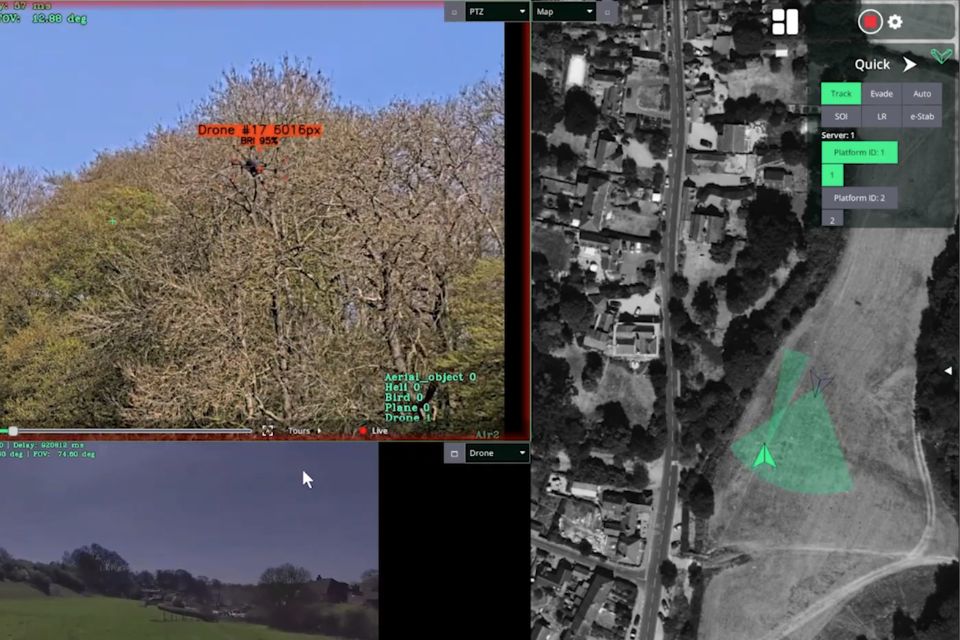
Vizgard’s FortifAI in action
Working with UKDI
Vizgard has been funded several times by UKDI, but it was their Security Open Call project where they overcame the greatest hurdles and challenges, helped by UKDI support.
“We had to completely re-architect the software,” Alex Kehoe, CEO of Vizgard explains. “Early on, FortifAI 2.0 could only handle one camera stream for one drone. For this project, we needed to process multiple streams simultaneously. It was a significant undertaking, but UKDI funding gave us the runway to do it properly.”
The result was FortifAI 2.0, a production-grade, scalable platform capable of handling dozens of concurrent streams. Today, it can process over 100. That leap didn’t happen in a vacuum: it happened because UKDI backed Vizgard at precisely the right moment; when the technology had real promise but needed investment to become operationally viable.
“UKDI gave us our very first commercial contract back in 2021, seeing something special in us before others,” Alex explains. “The project involved sea trials on the Royal Navy’s uncrewed test submarine, and it was the first time our AI was used in the real world. We fused radio tracks with visual AI to find vessels masking their identity, as well as showcasing automatic tracking of fast-moving vessels. This early validation opened doors for us with primes working in coastal security.”
The technology has moved quickly from funded prototype to frontline tool, with UK Policing exploring their application to drone and counter-drone operations.
The system not only gives users automated visual tracking of their own systems, but also continuous sky-scanning for other aerial objects. This tactical aid is valuable in operational contexts where a human observer watching the sky can easily miss something.
“Operators are inundated with visual sensor data in real time,” explains Alex. “Even the most skilled, attentive operator isn’t always going to be looking at the right camera stream at the right time. We help them know when they need to pay attention, and to what.”
This success is just what UKDI funding is designed to produce; innovations that reach end users and generate real-world impact. For Vizgard, the funding and engagement with UKDI has been a genuine accelerant. When they first engaged with UKDI, the company had around five employees, which has now risen to 20.
The future for Vizgard
Their ambition hasn’t slowed down. Vizgard secured £1.5 million in venture capital funding in early 2025, enabling them to develop UnifAI, a machine learning ops platform that streamlines AI model improvement in the field from weeks to days, even for non-technical users. They are now exporting the technology via a Defense Innovation Unit (DIU) contract for field testing with the US Marines.
This year, they secured a place in NATO DIANA’s competitive 2026 cohort for autonomous and unmanned technologies, being one of only 150 companies out of over 3,500 applicants. Closer to home, UKDI support has led Vizgard to work with Dstl on edge-based AI that helps quadcopter drones identify unexploded mines in automated ISR missions.
“Working with UKDI and Dstl has been excellent. It’s 100% funded, the application process is thorough but not unreasonable, and the projects were focused on genuine end-user problems,” says Alex. “As an SME, it provided crucial early funding to help accelerate our R&D and helped us get in front of potential end users both during the project and after.”