Lebanon
Warnings and insurance
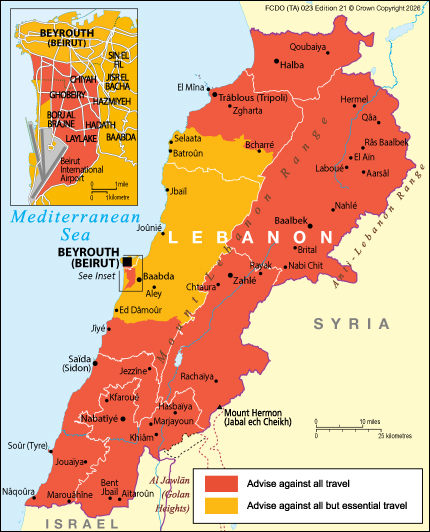
Your travel insurance could be invalidated if you travel against advice from the Foreign, Commonwealth & Development Office (FCDO). Consular support is also severely limited where FCDO advises against travel.
Areas where FCDO advises against travel
Areas in Beirut and Mount Lebanon Governorate
FCDO advises against all travel to the following areas of Beirut and its southern suburbs, excluding Route 51 from central Beirut to and past Rafic International Airport:
- Tariq el Jdideh and the area south of (but not including) Saeb Salam street between Ramleh al Bayda and Omar Beyhum street on the northern side of Horsh park to Tayouneh roundabout
- Ghobeiry and the area north of Ghobeiry but south of Yarmouk street, the war cemetery and Horsh park (not including Horsh park and the cemetery and Yarmouk street)
- Chiyah (south and west of the Rizkallah Semaan road)
- Haret Hraik
- Burj Al Barajneh
- Mraije
- Laylaki
- all other areas west of the Camil Chamoun Boulevard (south of Forn el Chebbak) that becomes the Old Saida Road through Hadath to Beirut airport
- the Area of Bir Hassan bordered by the following roads: West of Highway 51; East of Beirut Saida Highway; South of Ghobeiry Road; North of Abbas El Mousawi; but excluding the neighbourhood block containing the Rafiq Hariri hospital, Ministry of Public Health and Qatari Embassy (which is bordered by Ali Said al Khansa road in the west, Ghoberi Road in the north and Ghoberi Road south and Highway 51 in the East)
FCDO advises against all travel to:
The area of Mount Lebanon Governorate south of (but not including) the road from Khiam El Damour in the west (and extending to the Mediterranean Sea), which travels through the villages of, Kfar Him, Deir El Qamar, Barouk and Maaser El Chouf, to where the Barouk-Joub Jannine Road crosses the Mount Lebanon-Beqaa Governorate boundary in the east.
FCDO advises against all but essential travel to the rest of Beirut and Mount Lebanon Governorate.
Areas in the South and Nabatiyeh Governorates
FCDO advises against all travel to South and Nabatiyeh Governorates.
Areas in the Beqaa Governorate
FCDO advises against all travel to the Beqaa Governorate.
Areas in the Baalbek-Hermel Governorate
FCDO advises against all travel to Baalbek-Hermel Governorate
Areas in the North Governorate
FCDO advises against all travel to the city of Tripoli and to the rest of Northern governorate north of the road running from Chekka to Ariz via Kousba, Ehden and Bsharri (but not including the road itself).
FCDO advises against all but essential travel to the rest of the Northern Governorate.
Areas in the Akkar Governorate
FCDO advises against all travel to Akkar Governorate.
Palestinian refugee camps
FCDO advises against all travel to the 12 Palestinian refugee camps. See Palestinian refugee camp locations on the UN Relief and Works Agency website.
Register your presence
Let the UK government know you’re in Lebanon, register your presence if you’re in Lebanon for further updates.
Regional escalation
Regional escalation poses significant security risks and has led to travel disruption.
British nationals should:
-
read If you’re affected by a crisis abroad - GOV.UK. This includes guidance on “how to prepare for a crisis” with suggestions on what you might include in your emergency supplies and “what to do in a crisis”
-
sign up to FCDO Travel Advice email alerts
-
monitor local and international media for the latest information
-
stay away from areas around security or military facilities
-
keep your departure plans under review, and ensure your travel documents are up to date
-
if you are advised to take shelter, stay indoors. An interior stairwell or a room with as few external walls or windows as possible may provide additional protection
Leaving Lebanon
There are a limited number of commercial flight options available, from Beirut Airport. If your presence in Lebanon is not essential, you may wish to consider departing - if you judge you can access these options safely. Check for the latest updates from your airline or tour operator, as well as the instructions from local authorities. If you are traveling by air do not travel to the airport unless your airline has confirmed your reservation.
Make sure you have access to emergency supplies and essential medication. Travel within or out of Lebanon is at your own risk.
Keep your departure plans under review and ensure your travel documents are up to date, including any visas required for onward travel.
Conflict affecting Lebanon
Since 2 March, conflict in Lebanon has escalated in response to regional events. Airstrikes and rocket attacks between Israel and Lebanese Hizballah have increased. Widespread evacuation warnings have led to mass movement of people from conflict-affected areas. On 4 March, the IDF instructed people to leave all areas south of the Litani River.
Israeli airstrikes have occurred primarily in areas south of the Litani River, Beirut’s southern suburbs and Baalbek-Hermel Governorate. The IDF regularly releases evacuation warnings before airstrikes, but many have taken place with no advance notice. The dynamic nature of the conflict means airstrikes have also taken place outside these areas. British nationals should follow local, international and social media to keep up to date with official alerts.
We advise you to keep up to date with the latest situation including using multiple media sources to understand frequency and location of strikes as these may change rapidly. There are various mapping sources available online.
Access to Beirut airport
Beirut airport is open and operational. If you are travelling to the airport, check the local security situation before you travel. Remain alert to local conditions as these could change quickly.
Civil disorder
Celebratory gunfire is common in Lebanon and there is a risk from gunfire being fired in residential areas in reaction to major regional developments. If you hear gunfire, take cover immediately. Protests related to regional events could also take place at short notice and may escalate quickly. Exercise caution, avoid demonstrations, and monitor local media for developments.
Local support
The Embassy is open as normal and continues with essential work, including full services to British nationals.
Keep up to date with local and international media including TV and radio stations such as Virgin Radio Lebanon (FM 89.5) and Voice of Lebanon / Sawt Lubnan (FM 100.3 - 100.5) which may be useful sources of information on any developments.
You should have a personal emergency plan that does not rely on the UK government. This may include the ability to leave quickly or to shelter in place if you judge it necessary and safe to do so.
Read FCDO advice on what to do if you’re affected by a crisis abroad and how to prepare.
Help and support in Lebanon
You can contact the emergency services by calling 112.
If you need urgent help (for example, you’ve been attacked, arrested or someone has died), call +961 (0)1 960 800.
Travel insurance
If you choose to travel, research your destinations and get appropriate travel insurance. Insurance should cover your itinerary, planned activities and expenses in an emergency.
About FCDO travel advice
FCDO provides advice about risks of travel to help you make informed decisions. Find out more about FCDO travel advice.
Get travel advice updates
Sign up to get email notifications when this travel advice is updated.
Follow FCDO: